
You’ve Built an Exceptional Life. Here’s Why Your Kids Aren’t Following.
I want to tell you about a morning at an ice rink in Switzerland.
I was there with my four young children, one of them still a baby I was keeping warm while the other three, aged five, seven, and nine, had to rent their own skates, figure out their sizes without my help, and lace up those tall, stiff ice boots themselves. They managed. Not perfectly. They probably had to stop and readjust. But they managed.
Then a class arrived from one of the most exclusive private schools in the city. I recognized some of the children – they were my son’s age, around nine. The class was small, as those classes always are. Two teachers for a handful of children. Every resource. Every advantage.
And I watched every single one of those nine year olds queue up to have their laces tied for them.
I stood there thinking: these are the children of the most successful parents in this city. And what their considerable school fees are buying them, among other things, is that they never have to struggle with a shoelace.
I also thought something else. Something I have thought many times since, watching the children of ambitious, accomplished, high-achieving parents move through the world:
These children are going to have a very hard time when the teachers run out.
The Paradox at the Heart of Ambitious Parenting
If you have built an exceptional life – and I mean that genuinely, not as flattery – there is a very high probability that difficulty played a significant role in building it.
Not manufactured difficulty. Not artificial hardship imposed for character-building purposes. Real difficulty. The kind that comes from wanting something and having to fight for it. From falling short and having to get back up. From navigating circumstances that didn’t accommodate you, people who didn’t believe in you, situations that required you to figure it out yourself because nobody was going to figure it out for you.
That struggle, uncomfortable, sometimes humiliating, occasionally defeating, is where your capability was built. It is where you learned that you could handle more than you thought. Where you developed the drive, the resilience, the resourcefulness that now looks, from the outside, like exceptional success.
And there is an almost universal irony among parents who have built this kind of life:
They spend enormous energy ensuring their children never have to experience the things that made them who they are.
The love behind it is obvious. But the effect is the same regardless of the intention: the child grows up in a carefully managed environment that produces comfort, security, and very little of the internal equipment that actual life requires.
What Elite Actually Produces
The greatest footballers in the world were not, for the most part, produced by elite academies with pristine pitches, expert coaches, and carefully optimized training programmes. They were produced in the favelas of Brazil, the streets of Argentina, the dusty lots of West Africa – places where resources were scarce, competition was fierce, and the only way to get better was to want it badly enough to keep going when everything was against you.
This is not an argument against excellent coaching or good facilities. It is an argument about what actually builds exceptional people.
A child who succeeds in a class of eight is doing something meaningfully different from a child who succeeds in a class of twenty-five. The former has been given every advantage – the teacher’s attention, the individual support, the environment calibrated entirely around their needs. The latter has had to compete, to push, to find their way in a context that does not revolve around them.
Both children may perform well. But one of them has been building something the other hasn’t.
The most exclusive schools in the world are extraordinarily good at many things. Producing children who know how to struggle is often not one of them. Because struggle, by definition, cannot be purchased.
The Perfectionist Parent Problem
There is a second layer to this that I want to name directly, because it applies specifically to high-achieving parents.
People who have built exceptional lives tend to have high standards. For their work, for their relationships, for themselves. And when they become parents, those standards do not disappear – they extend to their parenting.
The result is a particular kind of parent who is simultaneously trying to give their child every advantage and trying to be the perfect parent while doing it. Who researches the best schools, the best activities, the best approaches… and then executes them with the same driven precision they bring to everything else.
What this produces, at its worst, is a childhood so optimized that there is no room left for the child to develop their own agency. Every problem is anticipated. Every difficulty is managed. Every shoelace is tied.
If this resonates, I’d encourage you to read what I wrote about the trap of the optimized childhood – and why the belief that you can engineer the right outputs from the right inputs is one of the most seductive and costly mistakes ambitious parents make.
The Berlin Sunday
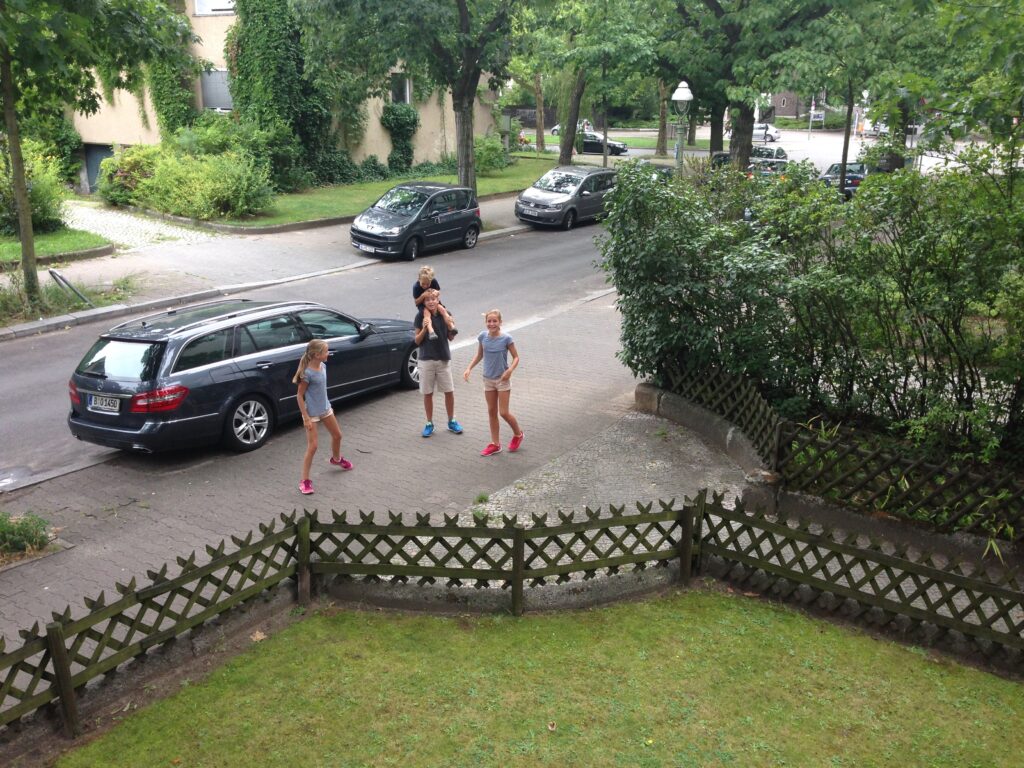
When we moved to Berlin, my oldest was fourteen. The others were twelve, ten, and four. We arrived in the middle of the night to an empty apartment filled with two hundred boxes.
The next morning, a Sunday, with everything still unpacked and nothing in the kitchen, I needed to deal with the most urgent tasks. So I handed my oldest some money, pointed them toward the U-Bahn, and told them to go find a cinema.
All four of them left together – fourteen, twelve, ten, and four years old. They barely spoke German. They had never been to Berlin. They had no smartphones, no Google Maps, no adult to navigate for them. What they had was each other and the confidence, built over years of being trusted with real things, that they could figure it out.
They spent five hours discovering the city. They were turned away from two cinemas for not meeting the age requirement. They found a third. They came home having memorized the entire underground system, flushed with the particular pride of children who have done something genuinely hard.
I have a photograph I took from the balcony as they left that morning. My eldest, fourteen years old, with his four year old brother on his shoulders. His two sisters beside him. Four children setting off into an unknown city, entirely on their own.
That photograph is not a record of a parenting experiment. It is a record of a Sunday morning when I had two hundred boxes to unpack and trusted my children to handle what was theirs to handle.
What they gained that day, the competence, the confidence, the sibling bond forged in the adventure of it, could not have been purchased at any school at any price.
What Your Children Actually Need From You
I am not arguing for artificial hardship. I am not suggesting you manufacture struggle or withhold advantages you can provide. I am deeply opposed to the idea that difficulty is inherently good – it is not. Unnecessary difficulty is just unnecessary.
What I am arguing is this: the difficulty that comes naturally – from real life, real circumstances, real situations that require something of your child – is not your enemy. It is the material from which competent adults are built.
Your job is not to remove it. Your job is to trust that your child can handle it.
That trust is harder than it sounds. Especially for a parent who is accustomed to solving problems efficiently. Especially for a parent whose instinct, honed over a successful career, is to identify what needs fixing and fix it.
The shoelace takes thirty seconds to tie. Of course you can tie it. The question is whether you should.
The high-achieving parents I work with are almost always surprised by the same thing: how much of what their children are struggling with traces back not to the children’s limitations but to how little they have been trusted to exceed them.
Your children are more capable than you are allowing them to be.
That is not a criticism. It is the most common thing I see in parents who have built exceptional lives… and the most straightforward thing to change.
If you recognize your family in this and you want to close the gap between the life you’ve built and the one your children are building – this is the work I do.